
Cart
0
You may also like
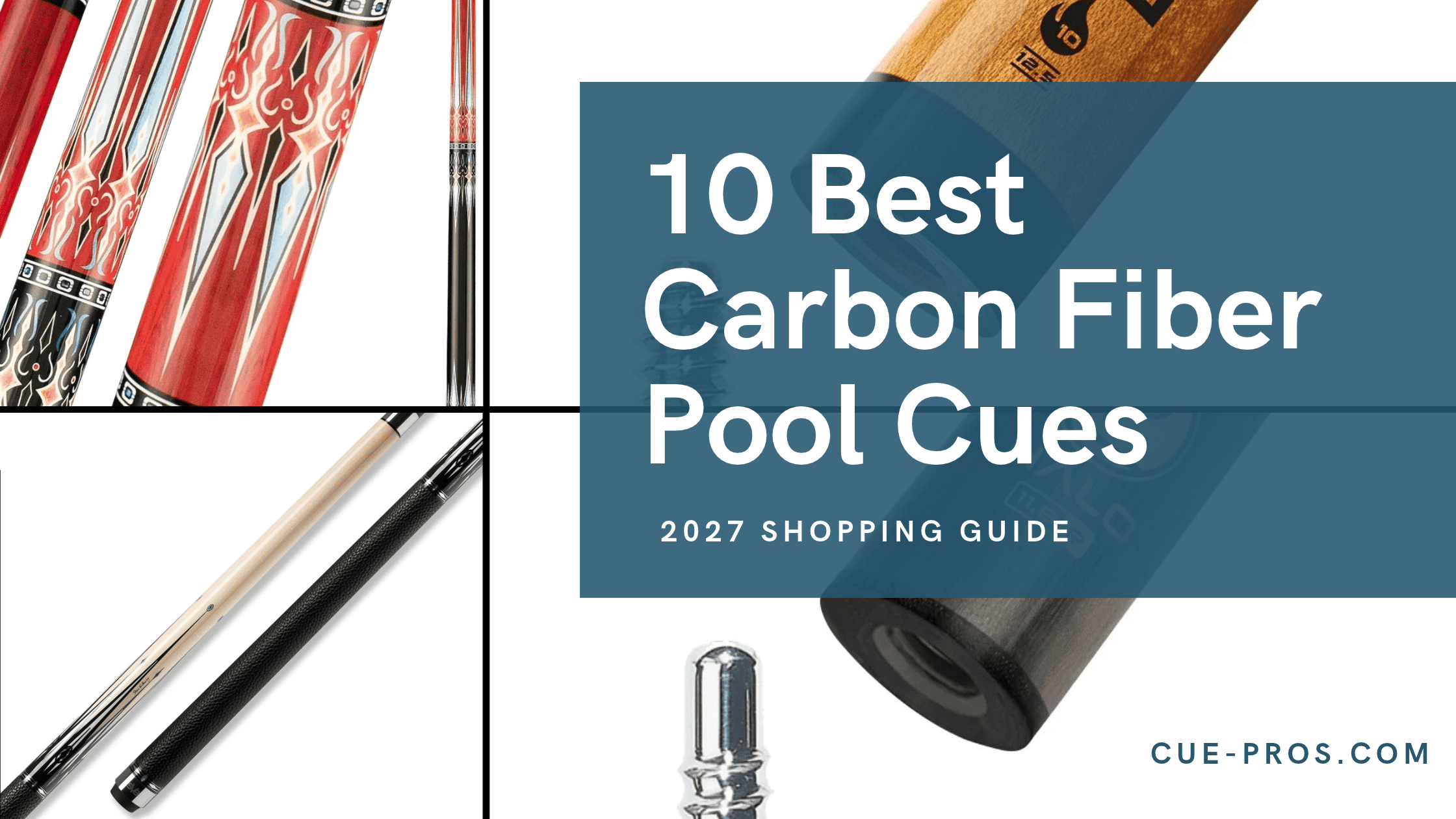
Carbon fiber pool cues have revolutionized the billiards world, offering players cutting-edge technology for enhanced performance and durability. The appeal is that they offer high-tech alternatives to traditional wood cues. Carbon fiber pool sticks utilize advanced materials originally developed for aerospace and automotive industries, and are trusted by professional players across the world. In fact, many of our top recommendations were created with guidance from some of the best pool players in the game today.
Understanding whether a carbon fiber cue suits your playing style starts with a real-world examination of your options, their features, and price points. It also requires examining both the remarkable advantages and potential drawbacks these innovative tools present. Let's take a deep dive into some of the best carbon fiber pool cues on the market, and then look at what you should consider when shopping for one.
|
Cue |
Best feature |
Starting Price |
Type |
Shop |
|
Cuetec Cynergy SVB Gen II |
Official cue of SVB |
$949 |
Two-piece |
|
|
Lucasi Pinnacle Coffee Wash |
Best classic finish |
$799 |
Two-piece |
|
|
Valhalla Carbon Series |
Most affordable carbon fiber two-piece |
$399 |
Two-piece |
|
|
Cuetec Nineball Series |
Official cue of the WNT |
$899 |
Two-piece |
|
|
Triple 60 TSI Carbon Fiber Playing Shaft |
Most affordable shaft |
$359.10 |
Shaft |
|
|
Lucasi Pro Halo Carbon Fiber Shaft |
Best LD engineering |
$539.10 |
Shaft |
|
|
The Viking Siege |
Made in USA |
$450 |
Shaft |
|
|
Pure X Fuze Kielwood |
Best hybrid |
$359.10 |
Shaft |
|
|
Triple 60 Hyper Jump |
Best jump cue |
$525 |
Jump Cue |
|
|
Cynergy Breach Break Cue |
Best break cue |
$749 |
Break cue |

The Cuetec Cynergy SVB Gen II's headline feature is simple and powerful: it is the official cue of Shane Van Boening, one of the most dominant American pool players of his generation. Van Boening is a Hall of Famer with World 9-Ball and 8-Ball titles plus five U.S. Open 9-Ball championships to his name, and he actually competes with this cue platform on tour. For a player who wants proof that the equipment can perform at the highest level, that endorsement carries more weight than any spec sheet.
The Gen II adds genuine refinements over the previous version, including a relocated A-joint for better balance and Cuetec's durable Clear-Tec epoxy finish. If you want a carbon fiber cue with professional credibility baked in, this is the obvious choice at $949.

The Lucasi Pinnacle Coffee Wash is one of the most popular carbon fiber cue's on our website, thanks in large part to the standout finish—a matte coffee-wash stain over Birdseye maple that gives the cue a warm, vintage character. Our players love how the LP30 wraps a modern shaft in a classic-looking package featuring six black points, Blue Lake inlay rings, and a subdued matte topcoat.
Under the finish, you're getting aerospace-grade carbon fiber performance in the shaft. The Fusion G5 rubber grip and Everest tip round out a package that feels refined rather than flashy, making it an easy recommendation for players who want their equipment to look as classic as their stroke. Buy it if you want the benefits of carbon fiber tech but refuse to sacrifice the traditional pool-hall aesthetic.
Shop the Lucasi Pinnacle Coffee Wash

The Valhalla Carbon Series earns its spot by doing something genuinely useful: it drops the entry price for a legitimate carbon fiber two-piece cue to $399, roughly half what most brand-name carbon cues command. Valhalla is Viking's entry-level line, designed by the same Wisconsin craftsmen behind Viking's flagship cues, and the Carbon Series pairs a genuine 12.50mm low-deflection carbon fiber shaft with Viking's proven butt construction and a lifetime warranty against warpage.
You also get Viking's interchangeable weight bolt system and a standard 5/16 x 18 joint, so you're not locked into a proprietary ecosystem. If you've been carbon-curious but couldn't justify the $700+ leap, this is the lowest-risk way to find out whether carbon fiber suits your game, backed by a name with decades of cue-making history.
Shop the Valhalla Carbon Series

The Nineball Series' defining trait is its status as the first-ever official cue collaboration with the World Nineball Tour, a joint development between Cuetec and Matchroom that took a year to bring to market. Cuetec built the cue around the demands of professional nine-ball specifically, pairing its tour-proven Cynergy carbon fiber shaft with a seven-point butt design featuring the Nineball diamond logo, a genuine pebbled full-grain leather wrap, and the Acueweight Gen II adjustment system.
Choose this one if you want a cue whose design brief was literally "perform under the arena lights at Mosconi Cup and World Pool Championship events," rather than a general-purpose carbon cue with some tour branding sprinkled on top.
Shop the Cuetec Nineball Indigo

The TS1's delivers genuine dual-core seamless carbon fiber construction with Micro-Compression technology and a multi-density fill pattern for under $400, undercutting most brand-name carbon shaft options while keeping the engineering claims credible. The shaft is also backed by a limited lifetime warranty, and Triple 60 offers multiple joint options so you can likely mate it to the butt you already own rather than buying a whole new cue.
Buy it if you're carbon-curious but want to spend shaft money, not cue money: this is a wallet-friendly way to test whether a carbon shaft's low-deflection, consistent feel actually suits your stroke, and if it does, you've saved enough to upgrade the butt later without feeling like you wasted the first purchase.
Shop The Triple 60 TS1 Carbon Fiber Playing Shaft

We chose the Halo for to represent low-deflection engineering because of how well it plays. It all starts with the carbon core, a T700 carbon fiber construction that keeps the front-end mass low and consistent so the cue ball tracks closer to your aim line on off-center hits. That mass reduction is paired with a Pro Taper that promotes a stable, repeatable stroke delivery. The bottom line is that the shaft's deflection characteristics stay remarkably predictable (and powerful). Plus, the Ivorine Juma ferrule and HOW Red Titan Medium tip give a solid, connected feel without the hollow feedback some carbon shafts produce.
Buy the Halo if you want serious low deflection from tip to core.

If you want an outstanding carbon fiber cue made right here in the U.S., the Viking Siege is our favorite for 2027. The Siege winds the carbon fiber and resin in a single continuous process, which eliminates the overlapping seams that introduce wall-thickness variation and radial inconsistency in conventional carbon shafts. The payoff is a shaft with more uniform stiffness around its circumference, so the hit feels the same regardless of how you rotate the cue.
Viking also builds in a Radial Dampening System that adds mass along the shaft's length to tame the hollow "ping" and vibration many carbon shafts produce. Buy it if you want carbon fiber performance with domestic manufacturing, a lifetime warranty, and a hit that won't punish your ears or your bridge hand with synthetic harshness.

We had to include a great hybrid on our list for those players who want to try something different. The Fuze Kielwood takes torrefied maple and infuses it with carbon to create a shaft that plays like an upgraded wood shaft rather than a carbon shaft in disguise The Kielwood process lowers front-end mass and deflection compared to standard maple while preserving the feedback, sound, and bridge-hand glide that carbon converts often miss. The lifetime warranty against warpage doesn't hurt either.
This is a great shaft for players who've already tried carbon and found it sterile, or who love wood but want lower deflection and better stability without committing to a full composite shaft.

The Hyper Jump's case as the best jump cue rests on two things: it was designed with direct input from Fedor Gorst, arguably the best jump player in the world right now, and its three-piece architecture is built entirely around the jump shot rather than adapted from a playing cue. The 29-inch shaft uses a strong European conical taper for stiffness, paired with a 14mm proprietary jump tip and a 7mm phenolic ferrule that together transfer energy into the cue ball with minimal loss. The 19-inch full forged carbon handle breaks down into a 15-inch handle and a 4-inch extension, connected by 5/16 x 18 quick-release joints, so you can shorten the cue for tight jump situations or extend it for longer, more controlled jumps.
If jumping is a genuine weakness in your game or if you want a dedicated tool that makes the shot feel more natural, look no further than the Triple 60 Hyper Jump.

The Breach is our resident pro player, Thomas Hart's, favorite break cue. The shaft is a 12.75mm carbon fiber composite built with a stiffer filament orientation specifically to maximize energy transfer into the rack, paired with Cuetec's Kintrol composite break/jump tip on a phenolic ferrule. That combination is designed to deliver power without sacrificing control, so you get a good spread and a predictable cue ball rather than a wild scatter. The butt is A+ grade kiln-dried Canadian maple with a satin forearm and high-gloss handle, and the Acueweight system lets you tune the weight across 18 to 21 ounces to match how you break.
Buy it if you're serious about the opening shot and want a cue that treats the break as its own skill rather than an afterthought.
Shop the Cynergy Breach (Ghost Edition)
If you're even slightly familiar with pool cue construction, you probably know that carbon fiber comes at a higher price point. So why is that? What sets it apart? Creating these cues involves layering carbon fiber fabric and bonding it with high-strength resins under extreme pressure and heat. This process creates a shaft that combines exceptional strength with remarkable lightness, offering players a durable and easy-to-handle alternative to wood.
Another key advantage of carbon fiber is the manufacturing precision it allows. The engineering of each shaft centers around consistent spine alignment and uniform flex characteristics along its entire length, delivering precise and predictable performance. Unlike wooden cues, which vary due to natural variations in grain density, moisture content, and environmental changes, carbon fiber offers stability and uniformity. Additionally, carbon fiber cue construction helps minimize deflection, providing players with advanced control and accuracy during play. These unique characteristics make these cues resistant to warping and wear over time.
Because carbon fiber tends to provide more precision, durability, and strength, carbon fiber and hybrid pool cues are also increasingly the top choice for professionals. The level of consistency and reliability they offer makes them hard to beat. Traditional wooden cues, while still desirable, may not always deliver the predictable performance of a carbon fiber model.
With such advanced engineering behind their design, it's no surprise that carbon fiber cues offer a range of benefits that elevate the game experience. Let's take a closer look at the features that make this cue type a go-to option for many players.
Since carbon fiber cues resist warping, dents, and damage, they ensure more reliable performance across countless matches. These cues can withstand impacts that could eventually damage or destroy traditional wooden shafts. That's why many players choose to use them specifically for the aggressive break shot.
The material's exceptional resistance to temperature and humidity changes means your cue maintains its straightness and performance characteristics regardless of environmental conditions. This robust construction makes them ideal for frequent travel, tournament play, or high-volume practice sessions where durability becomes paramount.
The uniform construction of carbon fiber eliminates the natural variations found in many wood cues, helping them achieve the shot-to-shot consistency that serious players demand. Every stroke feels identical, allowing you to develop muscle memory and confidence in your technique without compensating for shaft irregularities.
This consistency extends to the cue's flex characteristics and hit quality. While wooden cues may develop dead spots or inconsistent responses over time, carbon fiber maintains its performance properties throughout its lifespan, providing reliable feedback that helps improve your game.
Carbon fiber's lightweight properties and precise engineering significantly reduce cue ball deflection, particularly on off-center shots. This technology allows for more accurate aim, especially when applying English or executing complex position play. The reduced mass at the tip end of the shaft means less unwanted cue ball movement, translating to improved accuracy on draw shots, follow shots, and side spin applications.
While carbon fiber pool cues offer numerous advantages, they aren't without their drawbacks. That's why it's crucial to consider both when deciding if this advanced technology is the right fit for your playing style and preferences.
Premium carbon fiber cues command significantly higher prices than comparable wooden alternatives, often starting around $500-$600 and reaching well over a thousand dollars. A good, professional carbon fiber cue will generally be priced in the $800-$1000 range. This investment may not suit casual players or those just beginning their billiards journey.
If you're interested in how you can score a deal on a carbon fiber, check out our guide to buying carbon fiber pool cues on a budget.
The unique vibration characteristics and feedback of carbon fiber create a distinctly different playing experience compared to traditional wood cues. Some players describe the feel as "dead" or lacking the natural resonance they've grown accustomed to with wooden shafts. This adjustment period varies among players, with some adapting quickly while others struggle to develop comfort with the different tactile response.
Unlike wooden cues that are simple to modify, refinish, or repair by most cue makers, carbon fiber presents significant limitations for customization. The material's construction makes it difficult to alter weight distribution, adjust flex characteristics, or perform repairs using traditional techniques. Players who enjoy personalizing their equipment or working with local cue makers to fine-tune performance may find carbon fiber's inflexibility frustrating. Additionally, tip replacement and ferrule work may require specialized knowledge and tools not commonly available to everyone.
Carbon fiber pool cues represent a genuine performance upgrade for players who compete, practice regularly, and rely on precise cue ball control. The durability, low deflection, and consistency advantages are real and measurable. The higher cost and different feel are equally real, which is why starting with a carbon fiber break cue is the smartest path for players who aren't sure yet.
For players ready to make the jump, the Cuetec Cynergy SVB Gen I is the best starting point for most — proven at the highest levels of the game, adaptable for players coming from wood, and available with same-day shipping at Cue-Pros.


